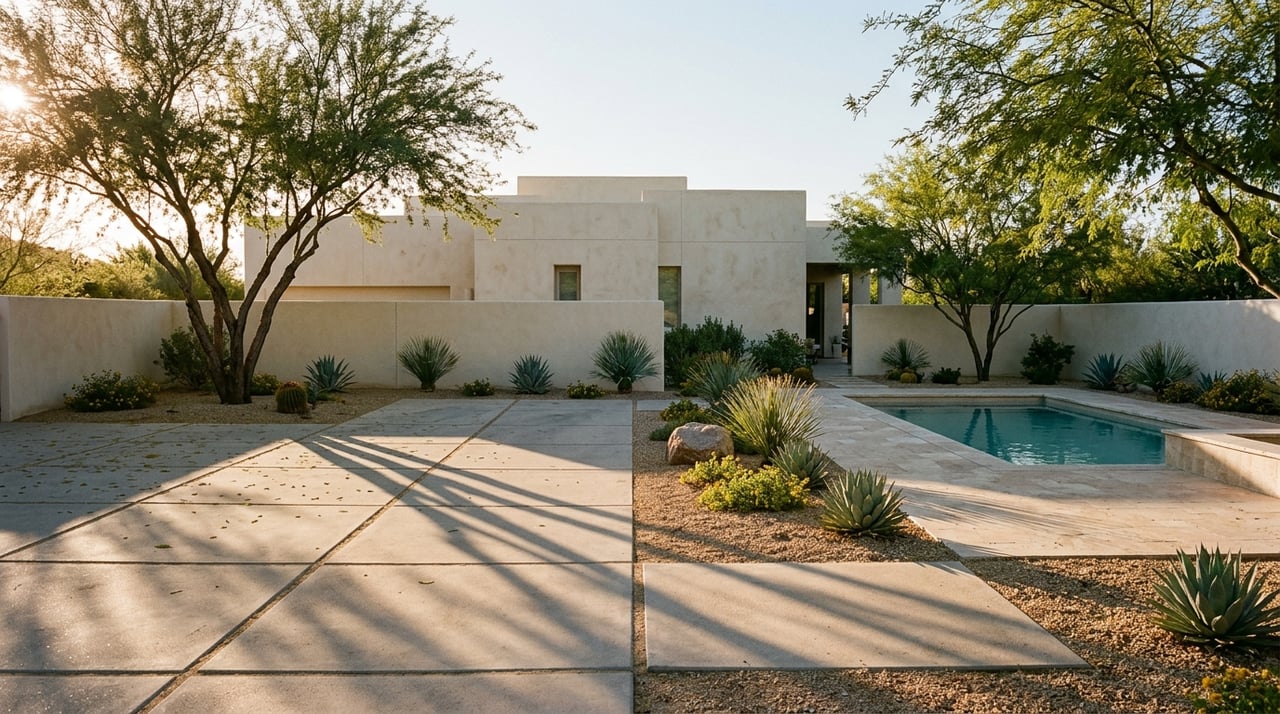
A lender's appraiser pulls up comps for a home in Paradise Valley this month and faces a problem most other towns don't create: every comparable sale in the ZIP code 85253 technically qualifies, and almost none of them are actually comparable. Pull the wrong one and a financed buyer either overpays or watches the deal collapse when the appraisal comes in short. This is why so many Paradise Valley closings never involve a lender at all. It is also the clearest evidence that the number everyone quotes about this market, the median sale price, is close to useless for anyone actually trying to buy or sell here.
In July 2026, a 20,900-square-foot estate at 5531 East Mockingbird Lane sold for more than $40.2 million in an all-cash deal, the most expensive home sale in Arizona history. Two miles away, a 1988-vintage, 5,000-square-foot home on a flat lot might close the same month for a fraction of that per square foot. Both sales happen inside the same one-square-mile-per-neighborhood town, under the same zoning code, and both get folded into the same headline statistic. The Mockingbird Lane sale doesn't tell a buyer shopping the middle of the market anything useful. What it does reveal, once you understand why it happened, is the actual mechanism driving prices in Paradise Valley right now.
What sold on Mockingbird Lane
The estate sat on two acres and had been built on speculation by Arcadia Custom Builders to a design from Candelaria Design. It hit the market in April 2026 asking $40 million and closed above that ask, eclipsing the previous state record of $33.5 million set in February 2025. The listing agent, Christie's International Real Estate's Katrina Barrett, told reporters that $2,000 per square foot is becoming the new standard for homes at this tier. The buyer, an entity called PRH5 LLC tied to an address near Houston, paid cash, which is typical: identity undisclosed, financing absent, appraisal risk sidestepped entirely.
That last detail matters more than the headline number. A cash buyer at this level never has to reconcile the price with what a bank thinks the house is worth. A financed buyer two tiers down does, and in Paradise Valley that reconciliation is getting harder, not easier.
The number an appraiser can't reconcile
Here's the friction. In the same stretch of 2026 that produced the Mockingbird Lane record, closings on older homes told a different story. Single-family homes built in 2019 or earlier, between 3,000 and 8,000 square feet, priced over $3 million, closed between April 8 and June 8, 2026 at an average of $795.80 per square foot. That's down nearly 5 percent from the $832.10 per square foot those same kinds of homes fetched in April 2024. Meanwhile, trophy-tier new construction on premium hillside lots was commanding $1,400 to $2,000 per square foot that same spring.
Put those two numbers next to each other and you get a spread of roughly 2.4 times between the softest and strongest ends of the market, within months of each other, inside the same town. A single ZIP code is producing two different markets that happen to share a mailing address. An appraiser working a financed deal on an older home has to decide whether the comps down the street from a 2019-vintage resale or the record-setting new build across town are the relevant reference point. Choose wrong and the number on paper stops matching reality, which is exactly why cash dominates the top of this market: it's the only way to close a deal without asking a third party to referee a valuation this stratified.
Why one town produces both extremes
The reason this split exists, and keeps widening, comes down to a zoning decision Paradise Valley made decades ago and has never walked back. Most of the town is zoned R-43, which requires a full acre of land per single-family home. Floor area is capped at 25 percent of the lot. Height is capped at 24 feet for anything under three acres. Any lot with meaningful slope, which includes much of the ground near Camelback and Mummy Mountain, goes through a Hillside Building Committee review before a shovel touches dirt. The town's own zoning ordinance states plainly that these height limits exist to preserve unobstructed views of Mummy Mountain, the Phoenix Mountains, and Camelback Mountain, a goal residents have held since incorporation.
That ordinance is also a supply cap. There are only so many one-acre parcels inside roughly 15 square miles, and the town has made it structurally impossible to add more by subdividing. Vacant land now typically starts around $3 million to $3.5 million per acre before anything is built on it. Custom construction runs $500 to $1,000 or more per square foot, the highest range anywhere in metro Phoenix, and a full build cycle takes 18 to 36 months, longer on hillside lots working through committee review. Add land, construction, design fees, and time together and you get a replacement cost, the price of recreating a given home from raw ground today, that has climbed well past what many existing homes are actually selling for.
That gap is the whole story. New construction keeps setting records because it's the only way to secure a lot with the view, the acreage, and the finish level buyers want, and building one from scratch now costs more than it did even two years ago. Resale homes, especially those built before 2019, are increasingly priced below what it would cost to reproduce them, because their sale price reflects the home as it sits, not the land-plus-construction math a builder would have to run today.
| New construction (spec-built) | Resale (2019 or earlier) | |
|---|---|---|
| Typical land cost | $3M to $3.5M per acre | Baked into sale price |
| Construction cost | $500 to $1,000+/sqft, up to $2,000/sqft at trophy tier | Not applicable |
| Timeline to occupy | 18 to 36 months | Immediate |
| Recent per-square-foot closings | $1,400 to $2,000+/sqft (hillside, trophy) | $795.80/sqft average, April to June 2026 |
What this means if you're comparing Paradise Valley to Arcadia or Scottsdale
Buyers cross-shopping Paradise Valley against Arcadia or North Scottsdale usually walk in holding one figure: the median. That figure is especially misleading here because Paradise Valley closes so few homes relative to its neighbors. Scottsdale and Phoenix each close 800 to 1,000 single-family homes in a typical month. Paradise Valley closes roughly 40 to 60, and each of those transactions runs 7 to 10 times the typical Valley price. A handful of trophy closings can swing the town-wide median by hundreds of thousands of dollars in either direction without reflecting anything about the middle of the market.
That's before accounting for micro-pocket differences that don't show up in a median at all. Homes with meaningful elevation on Camelback, particularly south-facing lots with unobstructed view corridors, routinely command a premium per square foot over flatland comparables just streets away. A comp from one pocket tells you almost nothing about a listing in another. This is also why most of Paradise Valley functions without a homeowners association. The one-acre minimum and the town's building code do the work an HOA would otherwise do elsewhere. The exceptions are the guard-gated communities, Clearwater Hills, Finisterre, Judson Estates, Azure at Ritz-Carlton, and Paradise Reserve, where HOA dues fund private gate staffing and shared landscaping rather than architectural review.
For a buyer genuinely comparing neighborhoods, the practical move is to stop asking what the median home costs in Paradise Valley and start asking what a specific pocket, built in a specific era, on a specific kind of lot, has closed at over the last six to twelve months. That's a harder question to answer from a portal search. It's also the only question that produces a number you can actually negotiate against.
Frequently asked questions
Is new construction always the better buy in Paradise Valley? Not necessarily. New builds command the highest per-square-foot prices because land and construction costs have pushed replacement cost higher than what many existing homes are trading for. A well-located resale, especially one that already sits comfortably within the lot's floor-area limits, can be the more efficient purchase if the layout and lot don't require major structural work to compete.
Why doesn't Paradise Valley have more HOAs? The town's own zoning does most of what an HOA would do in a denser city. The one-acre R-43 minimum, the 25 percent floor-area cap, and mandatory Hillside Building Committee review for sloped lots regulate density and architectural impact at the town level. HOA dues in Paradise Valley are mostly limited to guard-gated enclaves paying for private gate staff and shared landscaping, not architectural oversight.
If you're weighing Paradise Valley against Arcadia, Biltmore, or Old Town Scottsdale and want comps pulled for the actual pocket and build era you're considering, not a town-wide median, Phoenix Living can walk you through what a specific property should be worth before you write an offer. Get your instant home valuation to start the conversation.